
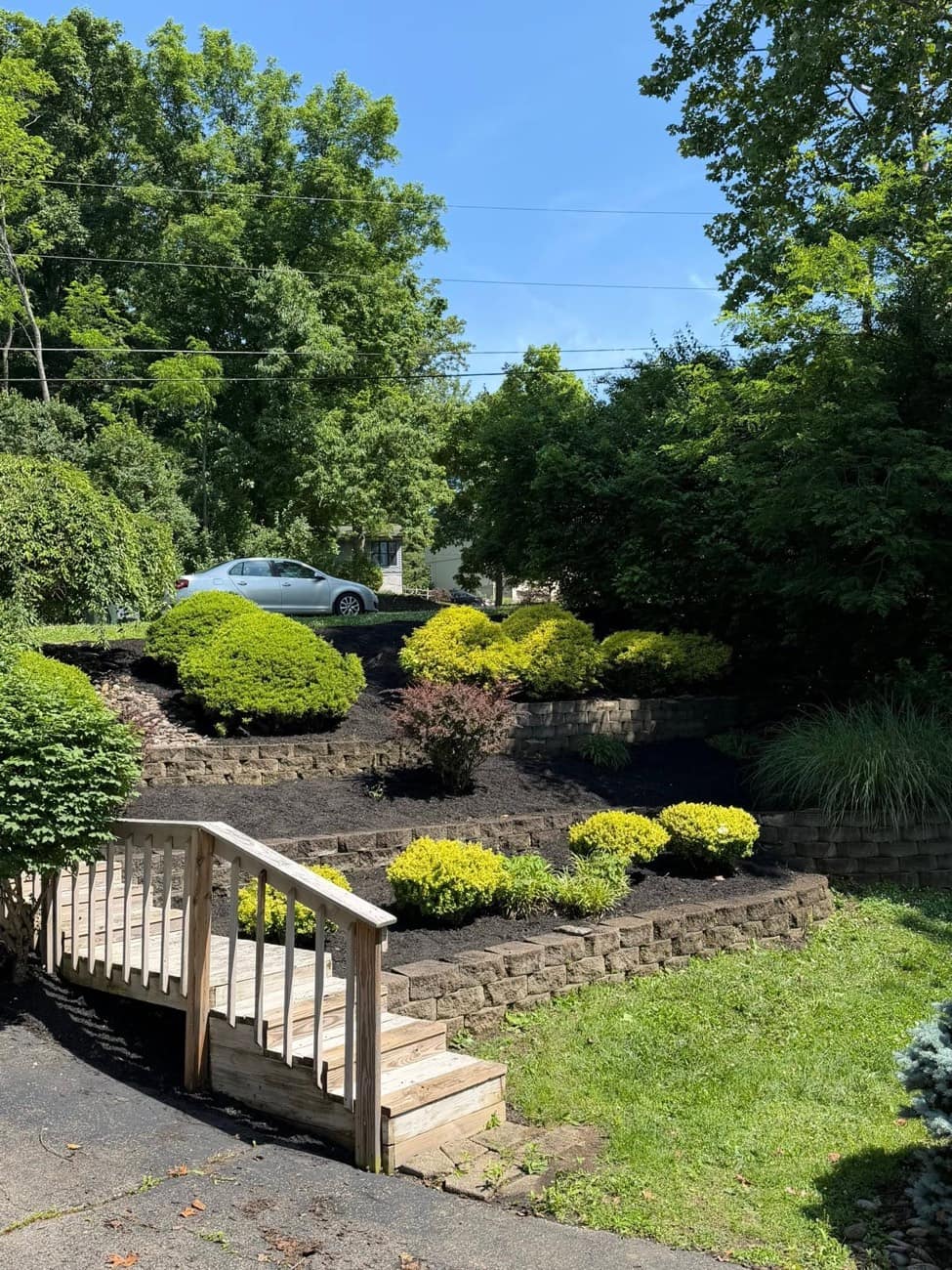
Hardscaping in Northern Kentucky
K&M builds retaining walls, paver patios and walkways across Boone County and Greater Cincinnati. Hardscaping here lives or dies on what's underneath — excavation depth, compacted base and drainage sized for Northern Kentucky clay and freeze-thaw. Licensed and insured, with free on-site estimates and a straight number after we walk the property.
What we build.
Retaining walls
New walls, terracing and replacement of leaning or bowing walls — with the base depth, gravel backfill and drainage that keep a wall standing in clay.
Paver patios & walkways
Outdoor living space and clean paths, excavated to depth and compacted in lifts so they stay flat instead of waving and settling after two winters.
Steps & landings
Proper steps cut into slopes, with consistent rise and solid landings — instead of the railroad ties and wobbling stones most hillside yards end up with.
Drainage & grading
The part that decides whether any of it lasts — water routed out from behind walls, out from under patios and away from the foundation.
Tear-out & rebuilds
Failed walls, cracked slabs and sunken patios removed and hauled off, then rebuilt on a base that fixes the reason the first one failed.
Done the way this ground demands.
Northern Kentucky is hilly, and our clay soil holds water. That combination is why so many walls around Florence and Union lean after a few winters, and why patios heave and open up at the joints. Clay doesn't drain — it swells when it's saturated, then freezes and expands again when the temperature drops. Good hardscape here isn't about the block or paver you see; it's about the excavation, compacted base and drainage you don't.
The freeze-thaw cycle is the part homeowners underestimate. Kentucky doesn't get one long freeze and one thaw — it cycles, repeatedly, all winter. Every cycle is another chance for trapped water to lift a paver a fraction of an inch or push a wall a fraction of a degree out of plumb. The only defense is getting water out from under and behind the structure before winter ever gets hold of it.
Hillside lots make the work harder and more worthwhile at the same time. A lot of Boone County backyards are half slope — technically yours, practically unusable. Terracing that grade, cutting a flat pad in for a patio, and putting real steps where people currently sidestep down a bank turns dead ground into the part of the property you actually use.
We handle the whole job with one crew: tear-out of what's failing, excavation and base prep, the build, then grading and cleanup. Hardscape projects rarely stay in one lane — a patio wants a wall to make the grade behave, and a deck often lands in the middle of it. Because we build all of it, the levels, water and materials get planned together.
Call us when
- A slope is eroding or sliding into the usable part of your yard
- An old wall is leaning, bowing, cracking or shedding block
- A patio or walkway has heaved, sunk, or grown weeds through every joint
- Water runs toward the house instead of away from it after a hard rain
- You want a patio or seating space where there's currently mud and slope
- You're planning outdoor living — patio, wall and deck as one build
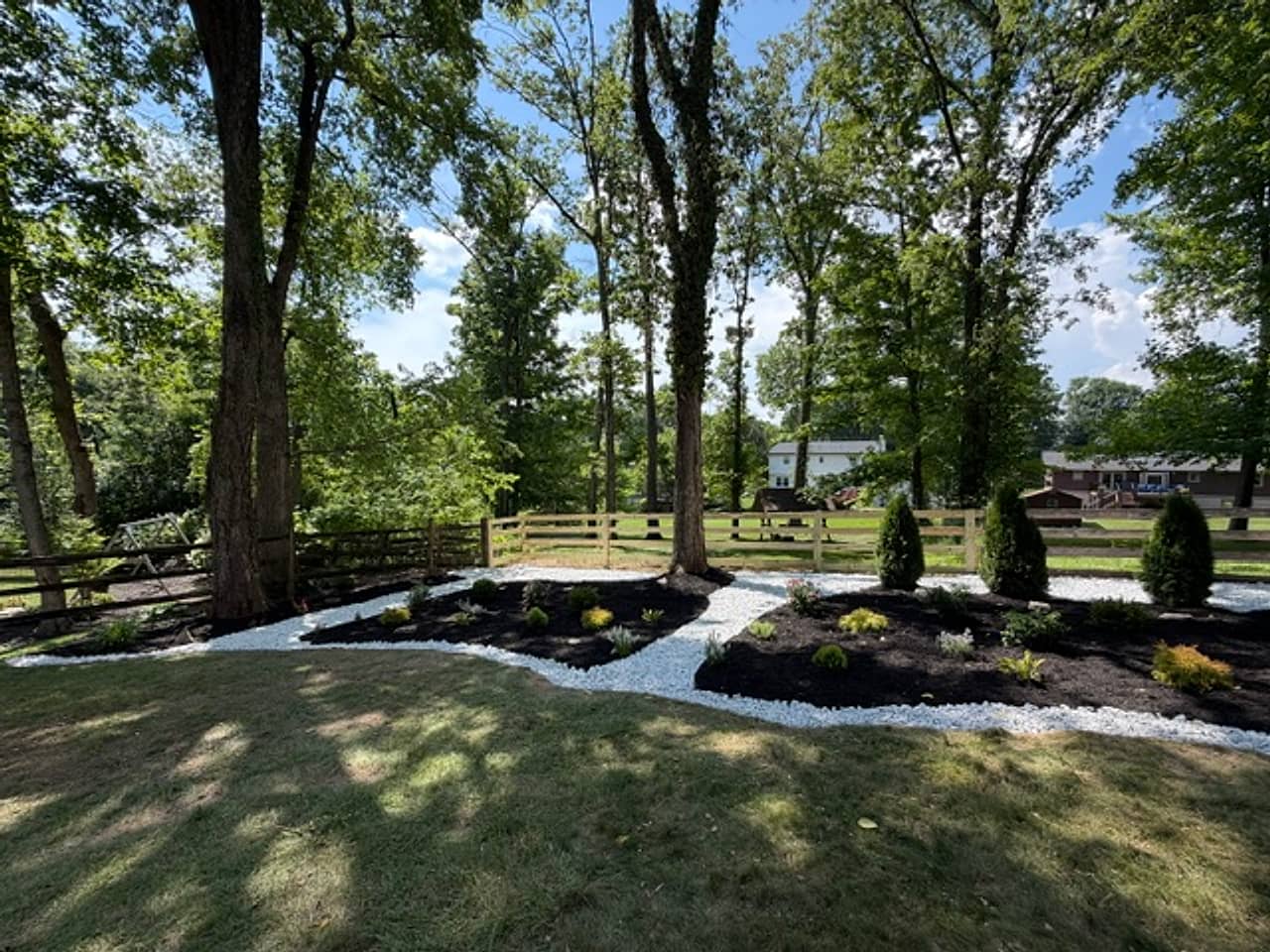
Gravel walkways and cut planting beds running through a shaded back yard
From first call to final walk-back.
Free on-site walk-through
We come out, walk the property with you and look at the grade, the soil and where water goes. No obligation, and no quoting a wall or patio over the phone off a photo.
A plan and a straight number
You get the layout, materials, height or square footage and what the drainage needs to be — plus one honest price. If permits apply, we tell you before work starts.
Demo and excavation
Failing structures come out and get hauled off. Then we dig — depth set by what's being built and by the clay underneath, not by what's quickest.
Base and drainage
Aggregate base goes in and gets compacted in lifts rather than all at once. Behind walls, clean gravel backfill and drain pipe give trapped water an exit.
The build
Block or pavers set to line and level, courses stepped as the design calls for, cuts made clean at edges and curves, then joints filled and the surface compacted in.
Grading, cleanup and walk-back
Final grading so water leaves the way it should, disturbed ground restored, the site cleaned up, and a last walk with you to confirm the job matches what we said.
What it can be built from.
Segmental block
The workhorse for retaining walls here. Interlocking units built over compacted base and gravel, so the wall flexes slightly with ground movement instead of cracking the way a rigid wall does.
Concrete pavers
Consistent thickness makes a flat, tight surface easier to hold. Individual pavers can be lifted and reset years later, so a repair disappears instead of leaving a patch.
Natural stone
Flagstone and quarried stone for a less uniform look. More cutting and fitting labor, more variation in thickness, and a look that suits older homes and wooded lots.
Gravel, fabric and drain pipe
The unglamorous half of the material list, and the half that decides whether the project lasts. Base aggregate, clean drainage stone, fabric where soils need separating, and pipe with somewhere real to go.
What hardscaping actually costs
We won't put a price on this page, because any number here would be a guess about a property we haven't seen. Two backyards a street apart in Florence can differ enormously — one is flat with room to back a truck up, the other is a steep clay bank a wheelbarrow has to climb. What we can do is tell you exactly what moves the number.
Size and height
Square footage on a patio and face footage on a wall are the starting point. Height matters more than length on walls — taller walls hold back more soil and need deeper base and heavier construction.
Excavation and soil conditions
How much dirt has to move, and what's in it. Rock, buried debris, old concrete or a previous contractor's failed base all add work before a single block gets set.
Site access
If equipment can reach the work area, the job goes faster and costs less. A backyard reachable only through a narrow gate means moving material by hand, and hand work is time.
Drainage requirements
Some sites need gravel backfill and a short drain line; others need water carried a long way to daylight. Where water has to go is one of the bigger swing factors on a wall.
Materials and cuts
Block and paver lines vary widely in price, and a curved or angled layout takes far more cutting than a rectangle. Caps, steps and edge restraints add beyond the field.
Demolition and haul-off
Removing a failed wall or a patio that's beyond saving is real labor plus disposal. It's usually worth doing right, and it belongs in the number honestly and up front.
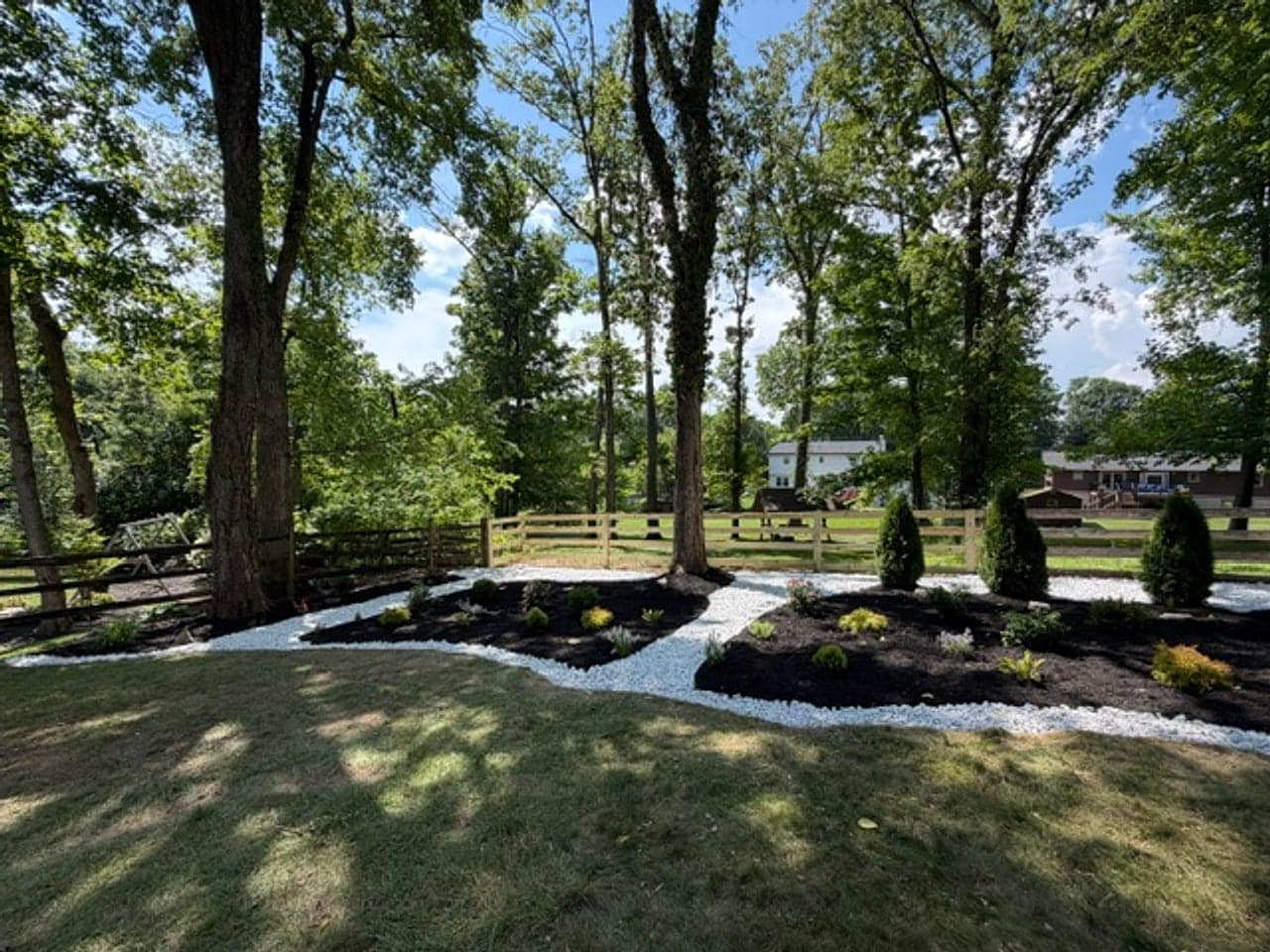
Stone edging and new evergreens along a rebuilt bed
Repair it or tear it out?
When a wall or patio is failing, the first question isn't what to build — it's whether what's there can be saved. Here's how we think about it on the walk-through.
Repair usually makes sense when
- The base is sound and the problem is limited to a section or a few courses
- Pavers have settled in one area but the field around them is still flat and tight
- The block or stone itself is in good shape and worth resetting
- Water is getting in from something fixable upstream — a downspout, a grade, a gutter
Rebuild is the honest answer when
- The wall is leaning or bulging — that's the base or the backfill, not the face
- There's no drainage behind the wall, which means it has to come apart to add it
- The patio was set on dirt or thin base and the whole field is moving
- You'd be paying twice — once to patch now, once to rebuild in three winters
Hardscaping, up close.
Hardscaping across Northern Kentucky.
Serving within 50 miles of Northern Kentucky.
Hardscaping questions.
Anything else — ask on the walk-through. You'll get the same straight answer either way.
How much does hardscaping cost in Northern Kentucky?
It depends on size, height, materials, access and how much excavation and drainage the property needs — which is why we quote from a free walk-through instead of over the phone. A flat backyard with truck access and a steep clay slope reached through a gate are different jobs. You get a real number, not a teaser that grows later.
How much does a retaining wall cost?
Height drives it more than length. A low garden wall framing a bed and a tall wall holding a hillside have different base depth, backfill and drainage requirements. Access and how far water has to travel to daylight matter too. We measure on site and quote the wall your slope actually needs.
Why do retaining walls fail in Northern Kentucky?
Almost always water. Our clay holds it, and a wall built without proper base depth, clean gravel backfill and a drain line ends up holding back saturated ground all winter. Add repeated freeze-thaw and the wall gets pushed a little further every year until it leans and lets go.
Why do patios sink and heave here?
Same reason, different structure. If the base isn't excavated deep enough and compacted in lifts, our clay moves it every winter — water gets underneath, freezes, lifts, thaws, and the surface settles unevenly. The fix isn't better pavers; it's doing the invisible work under them correctly the first time.
Pavers or poured concrete?
Both have a place. Pavers handle ground movement better because the surface is individual units that can shift slightly and be reset, so a repair disappears. Poured concrete costs less up front on a large flat area and makes sense for driveways, but when it moves it cracks, and that crack is permanent.
How deep does the base need to be?
It depends on what's being built and what's under it. Clay generally calls for more base than sandy ground, a driveway needs more than a walkway, and a wall's base goes deeper still. What doesn't change is that the base gets compacted in lifts rather than dumped and leveled.
Do I need a permit for a retaining wall or patio?
It depends on your city or county, the height of the wall, and where it sits on the property. Some projects need nothing, some need a permit, and taller structural walls can require engineering. We check what applies to your project and tell you on the walk-through — before work starts, not after.
Can you replace a wall another contractor built?
Yes — tear-outs and rebuilds are a regular part of our hardscape work, and we see plenty of walls built without drainage. We'll tell you honestly whether yours can be repaired or needs to come out, and if it can be saved we'll say so rather than sell you a rebuild.
What time of year is best for hardscaping?
Most of the year works. What matters is the ground — saturated clay after a long wet stretch is hard to excavate and hard to compact properly, and frozen ground has its own problems. Scheduling around weather is normal in this trade. Call whenever you're thinking about it and we'll be straight about timing.
Do you handle the whole project or just the hardscape?
The whole thing — demo, excavation, base, build, drainage, final grading and cleanup. If the project also involves a deck, a fence, concrete work or clearing the area first, the same crew handles that too. One accountable team from the first walk-through to the final sweep, residential or commercial.
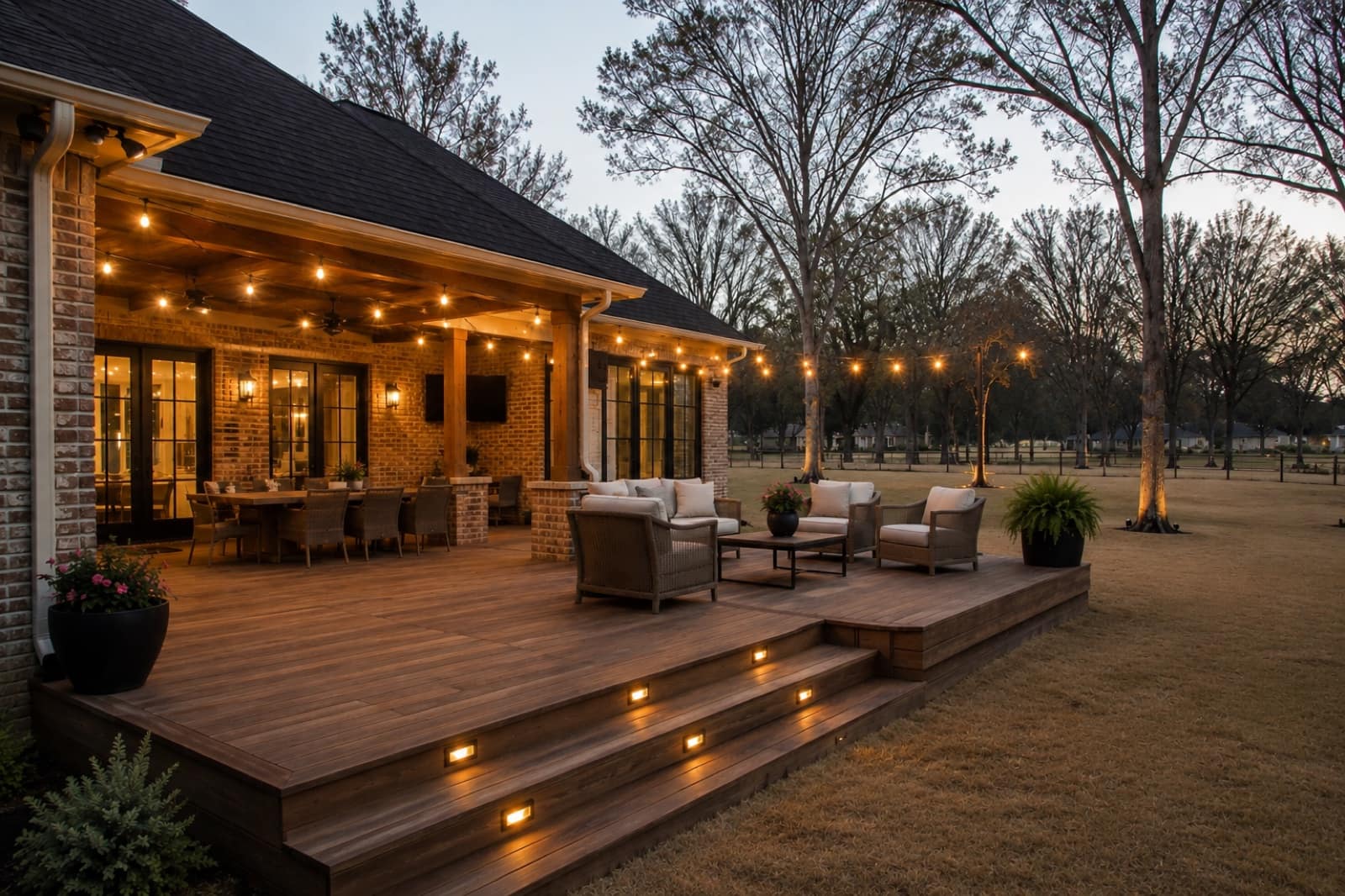
Tell us what the property needs.
Send it over or call — we'll come look, talk it through straight, and give you a number you can trust. No pressure, no runaround.
Call direct(859) 903-4098- 1
Call or send the form
Tell us what's going on with the property.
- 2
Free walk-through
We come look, talk it through straight, and give you a real number.
- 3
We do the work
Done right, cleaned up, and stood behind.