

Fencing in Northern Kentucky
K&M installs privacy, boundary and livestock fencing across Boone County and Greater Cincinnati — posts set deep enough for our clay, lines pulled straight over rolling ground, gates braced so they still swing in five years. Wood, vinyl, chain link and farm wire. Free on-site estimates, licensed and insured.
Fence work we handle.
Privacy fencing
Board and stockade privacy fence in wood or vinyl, set plumb and pulled straight, racked or stepped to match your grade, with gates sized for a mower.
Yard, picket & pet fencing
Lower fence that defines a yard without walling it off — picket, split rail and chain link builds that keep dogs and kids where they belong.
Boundary & line fencing
Long runs across acreage and property lines, often right after we clear them. Corners and ends braced to hold tension over distance and rolling ground.
Livestock & farm fencing
Board fence, woven field wire and high-tensile builds for horses and stock, with the corner and gate bracing that wire fence lives or dies on.
Gates & access
Walk gates and double drive gates on oversized, braced posts with hardware rated for the weight — the part of a fence that gets used every day.
Tear-out & replacement
Old fence pulled, posts and footings dug out and hauled off, new fence set in its place. Or one section rebuilt if the rest of the run has life left.
Done the way this ground demands.
Fencing in Northern Kentucky covers a lot of ground — literally. Privacy fence between houses in Florence and Union, picket and yard fence in the older neighborhoods, board and woven wire on acreage out past Walton and Crittenden. Different jobs, same failure point every time: the posts. A fence is a row of posts with something attached to them, and most of what goes wrong starts underground.
Our clay is the reason. It holds water, swells when it's wet and freezes hard in January. A post set too shallow gets lifted a little each freeze-thaw cycle until the line goes wavy and the gate stops latching. A post sitting in a bathtub of concrete that traps water rots from the ground line out. Depth below frost matters, and so does how the hole sheds water — a concrete collar crowned to drain away from the wood, or a tamped gravel set that lets water pass instead of holding it against end grain.
Then there's the ground, and very little of this county is flat. On a slope you either rack the fence so it follows the grade in one continuous line, or step it down in level sections and accept a triangle of daylight under each step. That call gets made before the posts go in. Same with corners, ends and gate posts — they carry all the tension in the line, so they get set deeper and braced harder than the run posts between them.
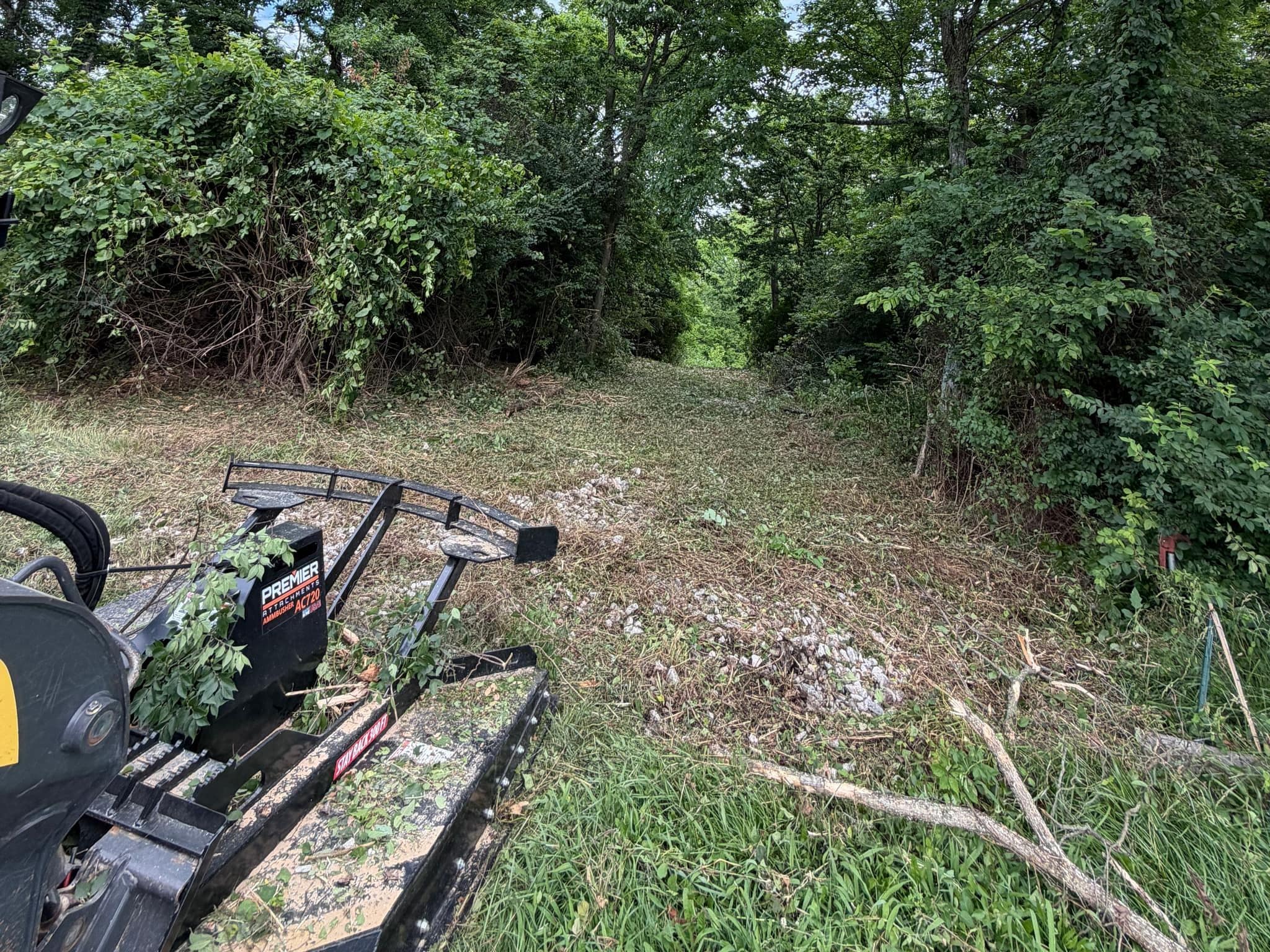
What's already on the line decides the rest. Honeysuckle, briars and volunteer cedar swallow a fence row in a few unmanaged years, and old woven wire grows straight into trees. Because we also do land clearing and tree work, opening the line and setting the fence is one crew and one number. Where the line falls is your call — if the exact boundary matters, get the pins located or a survey done first, and we'll set to whatever you mark.
Call us when
- The dog, the kids or the privacy situation needs a real fence
- An old fence is leaning, rotting or held up by the neighbor's side
- You've got livestock and a line that won't hold them
- Gates drag, sag or won't latch anymore
- A fence line is grown over and needs clearing before anything goes in
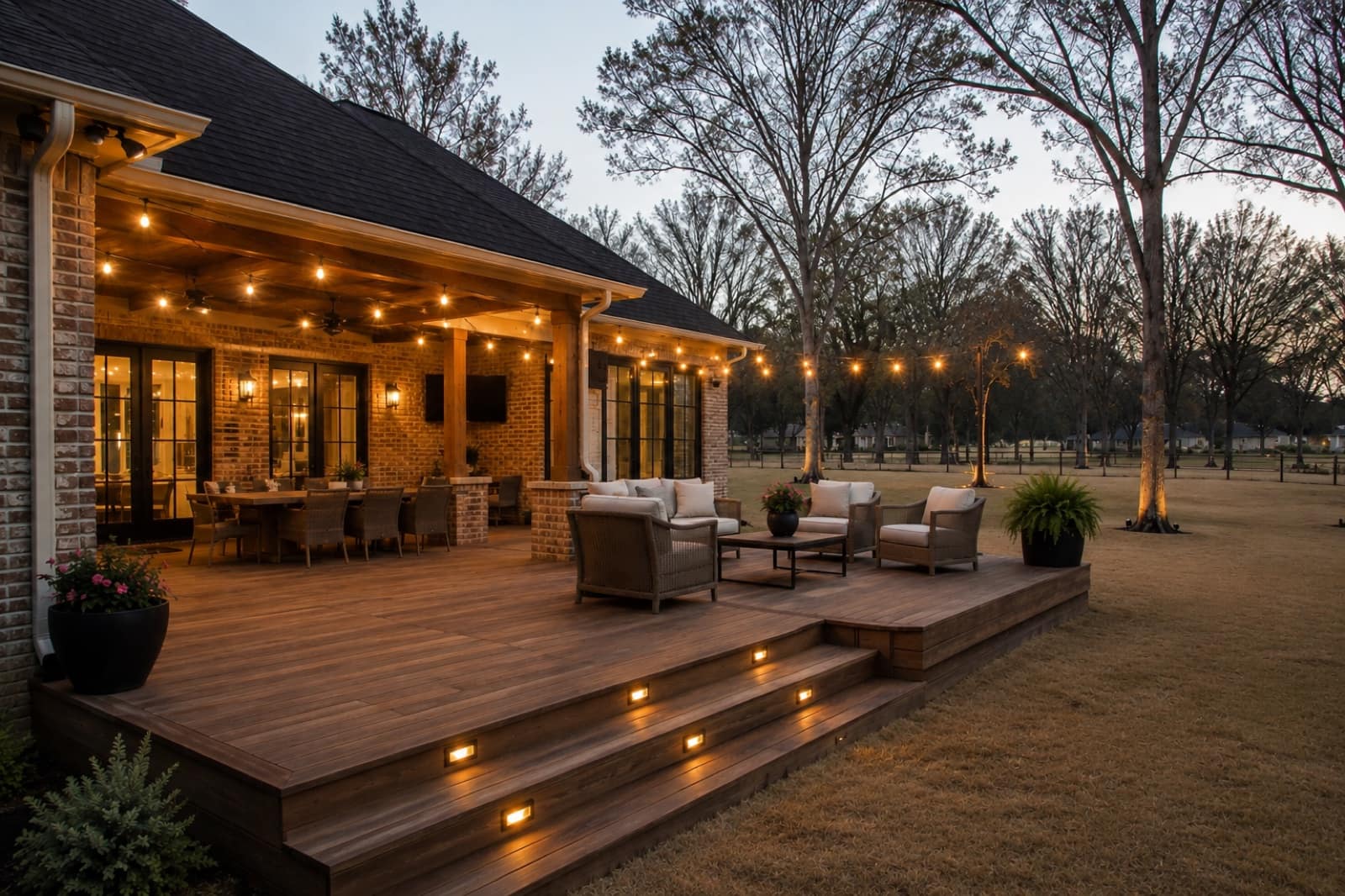
- You're building a deck or patio and want the yard enclosed to match
From first call to final walk-back.
Free walk-through and measure
We walk the line with you, measure the run, and look at grade, access and soil while we talk through material, height and where gates should go. No obligation, and the number comes from what we actually saw.
Layout, locates and line clearing
Corners, ends and gate openings get marked and the run gets strung. Utility locates are called in before any auger turns. If the line is overgrown, we open it up first with our own equipment.
Posts set first
Every post is dug to depth and set plumb — corners, ends and gate posts deeper and braced, run posts spaced for the material. Concrete gets crowned so water runs off instead of standing against the post.
Rails, boards, panels or wire
Once the posts have set, the fence goes on: rails and pickets, prefab panels, or wire stretched and tied off against braced corners. This is where racking or stepping the grade shows up in the finished line.
Gates hung, hardware set, site cleaned
Gates go on last, squared and adjusted so they swing clean and latch without lifting. Old fence, spoil dirt and scrap leave with us, and we walk the finished line with you before calling it done.
What it can be built from.
Wood privacy (board or stockade)
The default for back yards here. Mid-range up front and full height for screening, but it's wood outdoors — plan on staining or sealing it periodically, and expect some cupping and shrinkage as boards dry. Long-lived if the posts were set right and it gets maintained.
Picket & split rail
The lower-cost end of wood fencing. Picket defines a yard and holds a small dog without closing off the view; split rail marks a boundary or a drive and little else, though wire mesh behind it will make it contain something. Minimal upkeep beyond swapping a rail now and then.
Woven field wire & livestock fencing
For acreage, pasture and stock. Woven or high-tensile wire is the economical way to fence long runs, and the money goes into corners and braces more than the wire. Board fence for horses looks far better and costs considerably more, to build and to keep painted.
Chain link
The cheapest way to genuinely enclose a yard, kennel or commercial lot, and close to maintenance-free — galvanized fabric on steel posts outlasts most wood fence. It gives containment and security but no privacy, and it reads industrial in a residential front yard.
Vinyl
Highest up-front cost of the common privacy options and the lowest maintenance — no staining, no rot, wash it and leave it. The trade-offs: it's brittle in hard cold, damaged sections get replaced rather than repaired, and the posts still have to be set right.
What drives fence cost
Fence is priced by the foot, but the foot changes a lot depending on what it crosses. Two properties with identical footage can land a long way apart once slope, gates, soil and tear-out are in the picture. That's why we don't quote fencing over the phone — we measure the line, and the number reflects your ground.
Linear footage
The biggest single driver, and the one people misjudge most. A back-yard-only fence and a full perimeter are very different jobs, and every corner adds a post and bracing a straight run doesn't need.
Material and height
Chain link, split rail, picket, board privacy, farm wire and vinyl sit at different price levels, and going taller adds material, post size and post depth across the entire run.
Terrain and slope
Rolling ground costs more than flat. Racking a fence to follow grade takes more layout and cutting, stepping needs extra posts, and a hillside slows every single hole compared to a level yard.
Gates and openings
Each gate means oversized posts, extra bracing and real hardware. A double drive gate wide enough for a truck or tractor is a meaningfully bigger piece of work than another ten feet of fence.
Post setting and what's in the ground
Depth, post size and setting method all move the number — and so does what the auger hits. Shale, rock or old buried concrete turns quick holes into slow ones, and that shows up in the estimate.
Old fence removal and line clearing
Pulling posts, cutting out grown-in wire and hauling debris is real labor before the new fence starts. An overgrown fence row has to be opened first, and tight access means more hand work.
Repair the old fence or replace it
Most calls we get about an old fence are really this question. A good fence with two bad sections is not the same problem as a fence that has quietly reached the end, and it's worth answering honestly before you spend anything.
Worth repairing
- Posts are still solid when you push on them — the problem is boards, rails or panels
- Damage is confined to a stretch or two, usually storm or vehicle related
- The line is still straight and the gates still latch
- Rot is at the surface, not down at the ground line
- It's a style and height you still want
Time to replace
- Posts rock or lean when pushed — once posts go, everything attached follows
- The whole line has gone wavy from heave, not just one section
- Rot at the ground line on multiple posts, or wire that trees have grown into
- You're patching it every year and the patches outnumber the original
- You need different height, style or containment than it was ever built for
Fencing across Northern Kentucky.
Serving within 50 miles of Northern Kentucky.
Fencing questions.
Anything else — ask on the walk-through. You'll get the same straight answer either way.
How much does a fence cost in Northern Kentucky?
There's no honest per-foot number that covers every property. Footage, material, height, slope, gates and whether an old fence has to come out all move it — a flat back yard in Florence prices differently than a rolling perimeter on acreage. We measure the line for free and quote what we see.
How deep do fence posts need to be set here?
Deep enough to get below frost depth and into ground that doesn't move, which is deeper than most people expect and deeper than a lot of quick jobs go. Corner, end and gate posts go deeper still and get braced, because those carry the tension in the line. Depth is the cheapest insurance on a fence.
Should posts be set in concrete or gravel?
Both work when they're done right. Concrete gives maximum rigidity and is what we generally want under gates and corners, but it has to be crowned so water sheds away instead of sitting in the hole. A tamped gravel set drains and can be kinder to wood long-term. We match the method to the fence and the soil.
Do I need a permit or HOA approval for a fence?
Possibly. Height limits, setbacks, corner-lot sight rules, which side the finished face points and what a subdivision's covenants allow all vary by city, county and neighborhood — and they change. Worth checking before the posts go in rather than after, and we'll help you sort out what applies on the walk-through.
Do you locate my property line?
No — that's a surveyor's job, and where the fence goes is your call. If the exact boundary matters to you or your neighbor, get the pins located or a survey done before we start. You mark the line you want and we build to it. Plenty of people set slightly inside the boundary to keep things simple.
How do you fence a hillside or rolling ground?
Two ways. Racking lets the fence follow the grade as one continuous line — cleaner looking, no gaps underneath. Stepping keeps each section level and drops it at each post, which suits rigid panels but leaves a triangle of daylight at every step. We'll talk through which fits your slope and whether you need to hold a dog in.
Wood or vinyl for a privacy fence?
Wood costs less up front and takes whatever stain color you want, but it moves, weathers and needs maintenance to keep looking sharp. Vinyl costs more and gives that maintenance time back. If you're staying in the house long term, vinyl often pays off; if budget is the constraint, wood on properly set posts is a solid fence.
Do you remove the old fence?
Yes. Tear-out and haul-off can be part of the job, including digging out old posts and footings so the new line isn't fighting the old one. You're not left with rotted boards and rolled-up wire on the curb. It's real labor, so we account for it in the estimate instead of surprising you later.
Why do gates sag, and how do you stop it?
A gate is a lever, and all its weight hangs off one post. If that post is the same size and depth as the run posts, it slowly tips and the gate starts dragging. We use oversized, deeper-set, braced gate posts, keep the gate frame square, and hang it with hardware rated for the actual weight.
Can you clear an overgrown fence line first?
Yes, and it's one of the reasons people call us for fencing. We do land clearing, forestry mulching and tree work with our own equipment, so opening a grown-over fence row and setting the new fence is one crew and one estimate instead of coordinating two contractors and two schedules.
Tell us what the property needs.
Send it over or call — we'll come look, talk it through straight, and give you a number you can trust. No pressure, no runaround.
Call direct(859) 903-4098- 1
Call or send the form
Tell us what's going on with the property.
- 2
Free walk-through
We come look, talk it through straight, and give you a real number.
- 3
We do the work
Done right, cleaned up, and stood behind.