
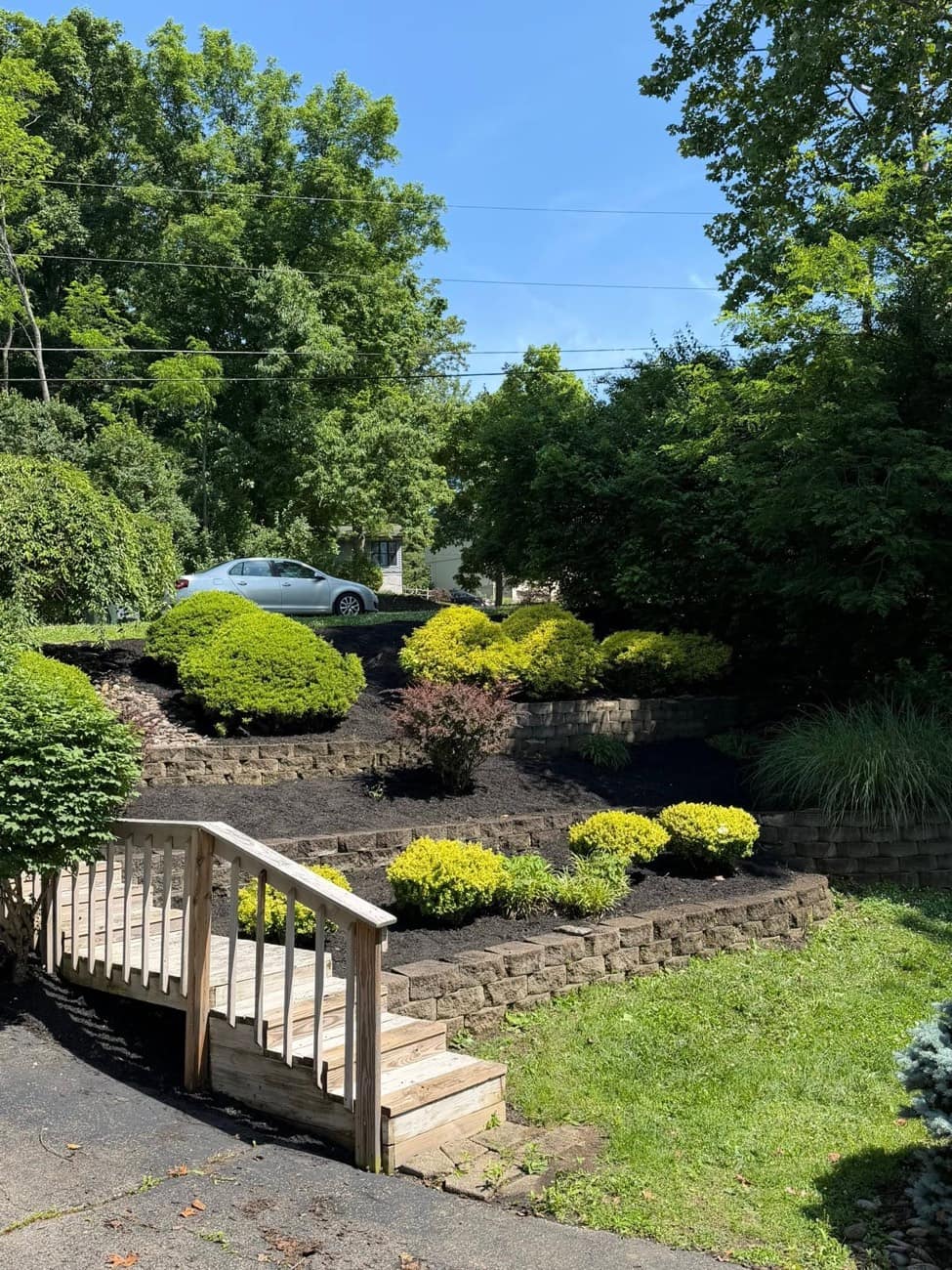
Paver Patios & Walkways in Northern Kentucky
K&M installs paver patios and walkways across Boone County and Greater Cincinnati — excavated to depth, set on base compacted in lifts, and edged so the perimeter holds. That's what keeps a patio flat through Kentucky freeze-thaw winters. One crew handles layout, prep, install and cleanup. Free on-site estimates.
Patio & walkway work.
Paver patios
Outdoor living space sized and shaped for how you'll actually use it — laid out on the ground so you can see the real footprint before we dig.
Walkways & paths
Clean, level paths from driveway to door or house to patio, replacing mud tracks and stepping stones that rock underfoot.
Steps & landings
Grade changes handled with proper steps and landings instead of an awkward slope you notice every time you carry something across it.
Patio + wall combos
Cut into a hillside and held with a retaining wall to create flat, usable space the lot never gave you.
Tear-out & replacement
Failing patios and cracked slabs broken out and hauled off, with the base excavated and rebuilt properly underneath rather than patched over and re-covered.
Drainage & grading
Pitch set away from the house, downspouts dealt with, low spots corrected — so water leaves instead of sitting on your new patio.
Done the way this ground demands.
A paver patio is only as good as what's under it. Northern Kentucky's freeze-thaw cycle finds every shortcut in the base work, and our clay makes it worse — clay holds water instead of draining it, that water freezes and expands, and whatever sits on top moves. That's why you see patios around Florence and Burlington with waves in them, sunken corners near the downspout, and joints full of weeds after only a few seasons.
The work that prevents all of that happens before a single paver is set. Topsoil and organic material come out completely, because they keep decomposing and settling under load. The dig goes deeper than the finished height requires, leaving room for a real aggregate base — compacted in lifts, several thinner passes instead of one deep dump. A plate compactor only densifies so far down, and the bottom of a thick layer stays soft no matter how long you run the machine over the top.
Water is the rest of the story. A patio should be pitched away from the house, never level: enough fall that rain sheds on its own, subtle enough that a table doesn't rock. Most hardscapers work somewhere around an eighth to a quarter inch of fall per foot. And because so many Boone County lots slope, a flat patio often means cutting into the grade and holding it with a retaining wall, or stepping down to the yard with landings. We build walls and decks too, so patio-plus-wall-plus-deck is one crew working off one set of elevations.
Call us when
- You want real outdoor living space, not a slab and two chairs
- An old patio is heaving, sinking or growing weeds through the joints
- Pavers along the edge have spread or crept out of line
- The walk from driveway to door is mud half the year
- A slope is eating the only flat part of your backyard
- You're pairing a patio with a deck, wall or fire feature
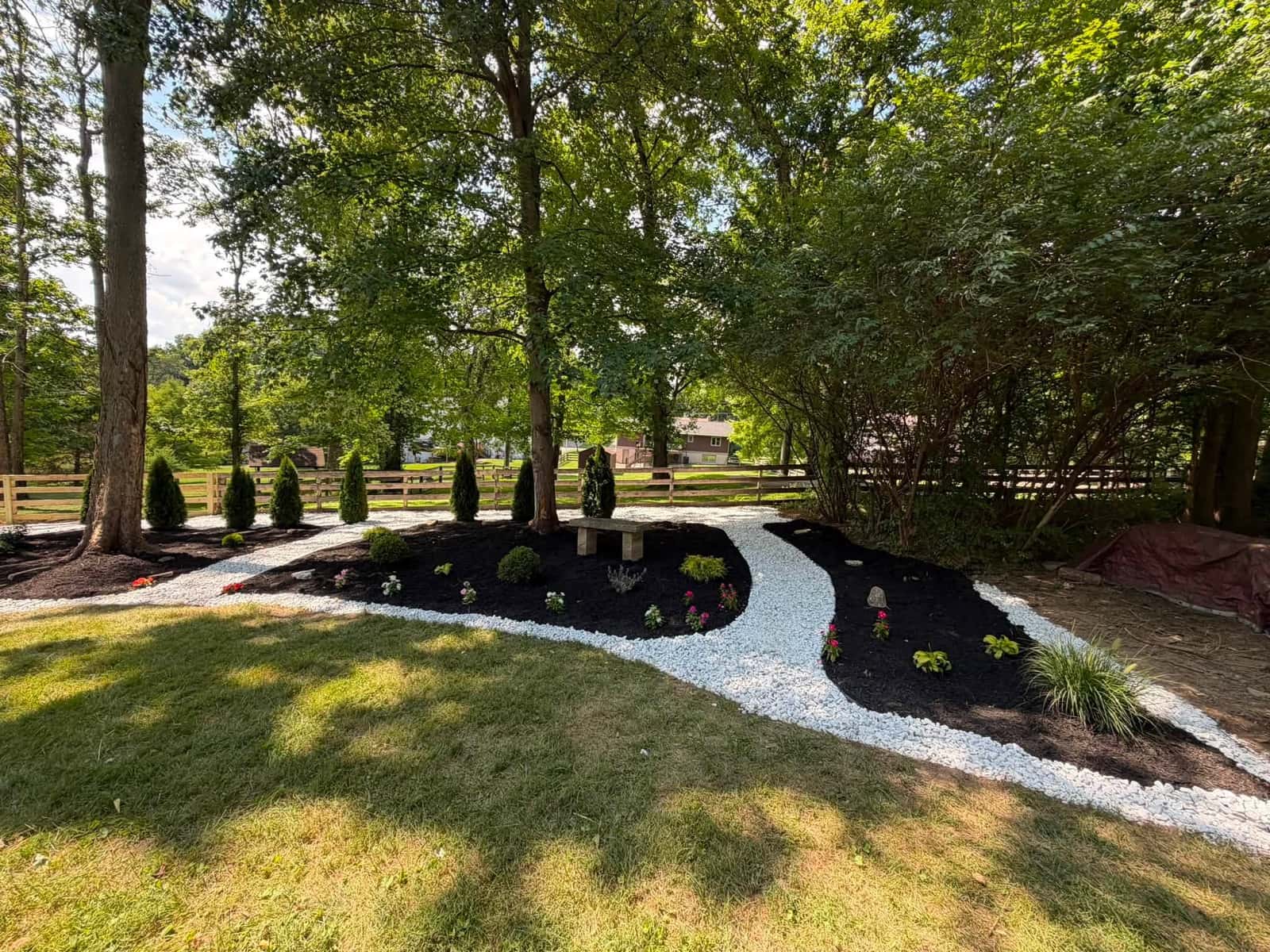
A gravel path and planted beds off the back of the house
From first call to final walk-back.
Walk-through & layout
We come out free, read the grade, drainage and access, and mark the footprint on the ground. Seeing the real size in your own yard changes a lot of plans before anything is committed to.
Excavation
Topsoil and organics come out entirely — they compress and rot. We dig deep enough for the base the soil and use call for, and deeper for anything that will carry vehicle weight.
Base & compaction
Aggregate goes in and gets compacted in lifts, with the pitch built in from the start. This step decides whether the patio is still flat in ten years, and it's the one most often shortchanged.
Setting bed & pavers
A screeded bedding layer goes over the compacted base, then pavers are laid to the chosen pattern, cut in at the borders, and worked to a consistent surface as the field comes together.
Edge restraint & joints
Edge restraint locks the perimeter so the field can't spread outward, then polymeric sand is swept into the joints and set — the combination that keeps weeds out and sand in.
Grading & cleanup
We restore the ground disturbed around the patio, confirm water runs where it should, and haul off spoil and debris. The yard gets left usable, not staged for another visit.
What it can be built from.
Concrete pavers
The workhorse here. Consistent thickness makes them fast to set, they flex with freeze-thaw movement, and a damaged one lifts out and gets swapped. Color can fade somewhat over years of sun.
Clay brick pavers
Hold color essentially forever, because the color is fired clay rather than pigment. A classic look on older homes. Fewer shapes and sizes available, and cuts are less forgiving.
Natural stone
Flagstone and cut stone look like nothing else, and no two patios match. Irregular thickness makes installation slower and pricier, and softer stones can spall over repeated hard winters.
Poured concrete
Least expensive per square foot and fine for simple shapes and utility areas. It will crack eventually in this climate — control joints steer where, not whether — and repairs always show.
What drives paver patio cost
There's no honest square-foot price we can put on a page. Two patios of identical size can be very different jobs once grade, access and demolition enter the picture. What we can do is tell you exactly what moves the number — then quote it from a free on-site walk-through instead of over the phone.
Square footage
The biggest driver, though not a straight multiplier — a larger patio spreads mobilization and setup across more area, so cost per square foot usually eases as the project grows.
Material and layout
Standard concrete pavers sit at the affordable end; natural stone costs most and sets slowest because no two pieces match. Curves, borders and herringbone add saw time that a running bond never does.
Excavation and base depth
How deep we dig depends on soil, drainage and whether anything will drive on it. Soft clay, wet ground or a driveway-rated build all mean more excavation, more aggregate and more hauling.
Access for equipment and material
If a machine can reach the work area, the dig and the material haul go fast. Narrow gates and tight side yards force wheelbarrow work, and that labor lands in the price.
Grade changes and steps
Flat lots are cheap to build on. Sloped lots need cut and fill, and often a retaining wall or a run of steps to create level space — structural work layered onto the patio itself.
What has to come out first
Demolition of an old slab, stump and root removal, or hauling off spoil all add scope before new work starts — as does correcting drainage we uncover during the dig.
Pavers vs. poured concrete
We install both, so we've got no reason to steer you. In Northern Kentucky the deciding factors are freeze-thaw movement, how the space gets used, and what happens the day something goes wrong.
Paver patio
- Individual units flex with ground movement instead of cracking across the surface
- A settled section can be lifted and relaid — the repair disappears
- Wide range of colors, textures, sizes and laying patterns
- Higher up-front cost, mostly in labor and base preparation
- Joints need occasional attention; re-sanding every several years is normal
Poured concrete
- Lower up-front cost, especially on simple rectangular shapes
- Continuous surface with no joints to sweep or refill
- Fast to place once forms and base are ready
- Cracks are a matter of when, not if, in a freeze-thaw climate
- Patches are visible — color and texture rarely match
- Still needs a compacted base; concrete on bad base fails just as fast
Patios & Walkways across Northern Kentucky.
Serving within 50 miles of Northern Kentucky.
Patios & Walkways questions.
Anything else — ask on the walk-through. You'll get the same straight answer either way.
Pavers or poured concrete — which is better?
Both have their place. Pavers handle freeze-thaw movement better and repair invisibly, because you lift and relay a section instead of living with a crack. Poured concrete costs less up front and suits simple shapes. We install both, so you get an honest comparison for your project rather than a pitch for one.
How much does a paver patio cost in Northern Kentucky?
It comes down to square footage, the paver or stone you pick, how much excavation and base the site needs, whether equipment can reach the area, and any steps or wall work the grade requires. That's why we quote from a free walk-through instead of over the phone.
Why do patios sink or heave around here?
Water and clay. If the base wasn't excavated deep enough, or the aggregate went in as one thick layer instead of compacted lifts, our soil moves it every winter. Organic material left underneath makes it worse as it decomposes. The fix is doing the invisible work right the first time.
What is edge restraint and why does it matter?
It's what locks the outer course of pavers in place. Without it, the field slowly pushes outward under traffic and freeze-thaw pressure — perimeter joints open, sand washes out, weeds move in. Patios that look like they're spreading at the edges almost always skipped or undersized this step.
Do you use polymeric sand in the joints?
Yes. It's swept into the joints and activated with water so it firms up, which resists washout and slows weed growth far better than plain sand. It isn't permanent — expect to refresh joints after several years, especially where downspout or hose runoff crosses the patio.
How long does a patio install take?
Most residential patios run a few days to about a week depending on size, access and what's paired with them. Excavation and base prep take the largest share of that. Weather matters too, since compacting saturated clay isn't productive. You'll get a real timeline with your estimate.
Can you build a patio on a sloped yard?
Yes, and it's common work on Boone County lots. Usually it means cutting into the slope and holding the cut with a retaining wall, or stepping the patio down in levels with landings. We build the walls and steps ourselves, so elevations and drainage get planned as one project.
Do I need a permit for a patio?
It depends on your city or county, and on what else the project includes — walls above a certain height, structures, or anything attached to the house can change the answer. We'll tell you what applies to your specific project on the walk-through, before work starts rather than after.
What areas do you serve for patio work?
We're based in Northern Kentucky and work across Boone County — Florence, Union, Burlington, Hebron and Walton — plus Greater Cincinnati and the surrounding area. If you're within about 50 miles, we'll come take a look. Residential and commercial both. Call (859) 903-4098 for a free estimate.
Tell us what the property needs.
Send it over or call — we'll come look, talk it through straight, and give you a number you can trust. No pressure, no runaround.
Call direct(859) 903-4098- 1
Call or send the form
Tell us what's going on with the property.
- 2
Free walk-through
We come look, talk it through straight, and give you a real number.
- 3
We do the work
Done right, cleaned up, and stood behind.